Learning and unlearning are not side effects of nature-based solutions; they are central to how transformation happens. Across TRANS-lighthouses, Living Knowledge Labs are spaces where communities, practitioners and researchers question assumptions, revisit habits and learn together. From everyday practices and our relation to nature to governance models, nature-based solutions become opportunities not only to build new knowledge, but also to unlearn approaches that do not fit ways of organising collective life and engaging with people and nature. They help initiate and sustain real and deep social and ecological transformation. This blogpost explores why learning and unlearning matter, and how they are taking shape across the project.
A reference framework for learning to unlearn
How do we create conditions not only to learn, but to unlearn?
One of the key scientific contributions emerging from TRANS-lighthouses is a reference framework for learning to unlearn in transdisciplinary Nature-Based Solutions (NbS) settings. Developed through conceptual reflection drawing on different strands of scientific literature on social and ecological transformation, empirical pilots and iterative dialogue across Living Knowledge Labs, the framework addresses a central challenge: transformation requires more than introducing new practices, it requires questioning the assumptions that silently shape them.
Crucially, the project moves beyond a simple substitution logic. Replacing techno-solutionism with “nature-based” interventions does not automatically transform underlying ways of thinking. If dominant ideas about efficiency, scale, governance or expertise remain unchanged, the solution may shift in form but not in logic. Learning and unlearning are therefore framed as processes that accompany NbS as they unfold, not as outcomes measured at the end.
Unlearning as a process of transformation
Learning is widely acknowledged in sustainability processes. Unlearning, however, is rarely addressed, especially in structured, collaborative NbS environments. The framework conceptualises unlearning as a multi-phase, processual dynamic. It unfolds through reflexivity, experimentation and critical dialogue, enabling actors to step back from entrenched routines, institutional logics and hierarchies of knowledge that may limit transformative potential. In this sense, unlearning is not replacement, it is an enabling condition for change.
Importantly, this reflection does not target communities alone. It also challenges researchers, planners and policymakers. In transdisciplinary NbS settings, knowledge is not merely applied, it is negotiated. Learning to unlearn becomes a shared endeavour, reshaping how problems are framed, how evidence is valued, and how responsibilities are distributed across actors, through plural dialogues centred on listening and open to dissent.
From framework to practice: the Cáceres experience
The decentralised composting pilot in Cáceres, Spain, offers a particularly strong empirical grounding for this framework. Often described within the project as a “pilot of pilots” for unlearning, it was designed not only to test decentralised composting initiatives, but to explore their transformative viability. By developing community-based composting systems, local actors directly confronted a dominant governance assumption: that effective waste management must be centralised, industrial and technologically intensive.
As composting initiatives were implemented, monitored and collectively discussed, practical tensions around scale, coordination, regulation and responsibility surfaced. The work was carried out not only with community participants but also with mapped receptive incumbencies. Researchers and community actors jointly identified key power actors in the domain, such as policy-makers, responsible authorities and representatives of large waste management companies, and invited them into the dialogue.
Rather than being treated as obstacles, these tensions became structured moments of reflection within communities of practice and dialogical spaces. Through hands-on experimentation and iterative adjustment, participants began to reconsider what counts as “efficient”, who holds responsibility for waste management, and how value circulates within local ecosystems. Composting thus became not only an environmental intervention, but a living laboratory for questioning institutional logics and rethinking established norms through lived experience.
Reframing Nature-Based Solutions
This interplay between conceptual foundations, living theory and praxis is central to the framework’s contribution. NbS are approached not as fixed technical packages to replicate, but as evolving transdisciplinary processes. Learning expands possibilities, and unlearning creates the conditions for transformation by reshaping how NbS are conceived, implemented and governed.
As TRANS-lighthouses continues, this reference framework is being refined across territories, dialogues and comparative analysis. Its ambition is not only to support better NbS implementation, but to advance how the field understands transformation itself.
Curious to explore how this perspective is unfolding across our pilots and Living Knowledge Labs?
Discover more on our website, explore our resources, and follow the journey across our lighthouses: www.trans-lighthouses.eu
TRANS-lighthouse glossary
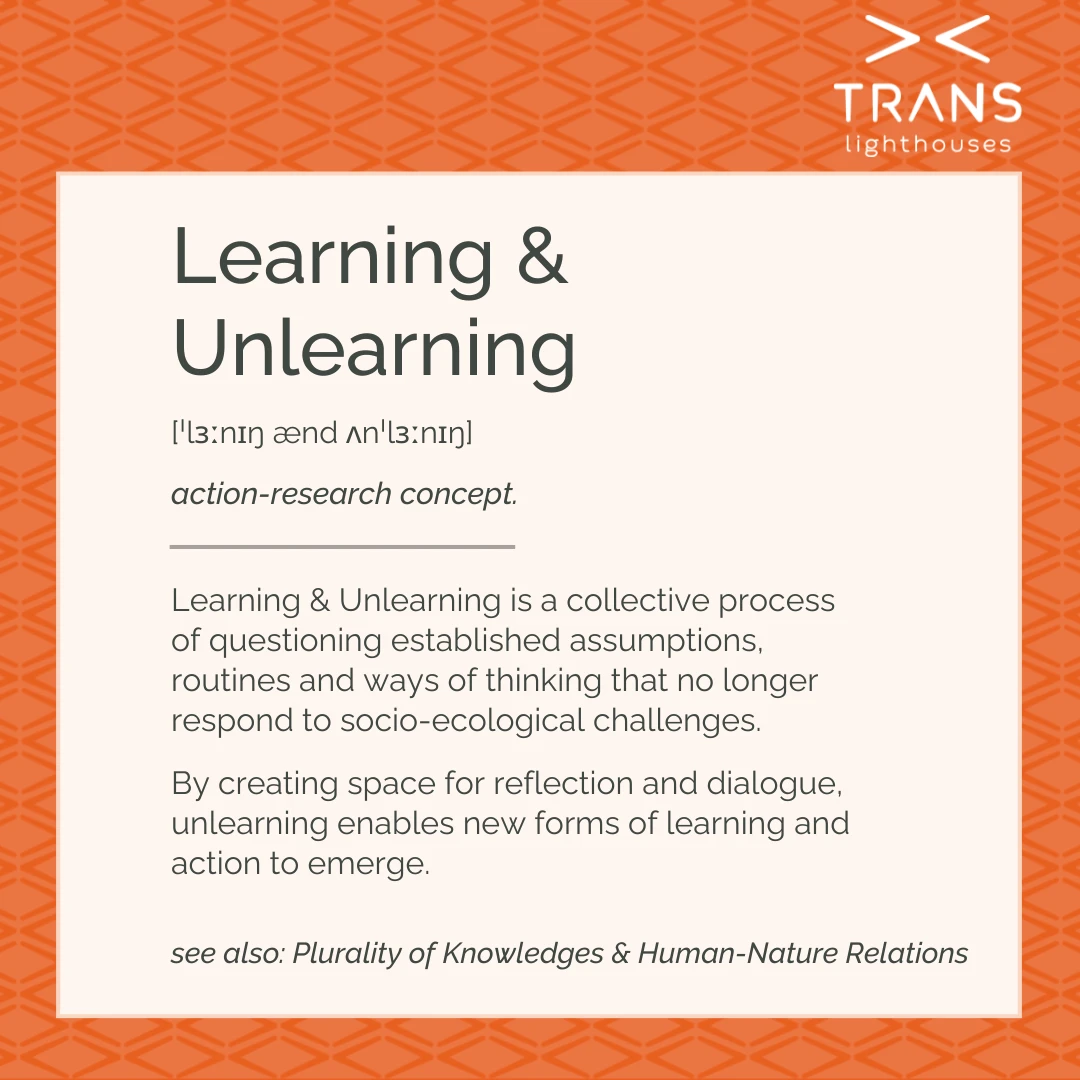
Learning & Unlearning
Unlock the language of Nature-Based Solutions: Your essential glossary for the TRANS-lighthouses project!
The featured entry on Learning & Unlearning is part of the TRANS-lighthouses glossary — a living resource continuously enriched throughout the project. Explore other entries such as:
Plurality of Knowledges & Human-Nature Relations
Column images
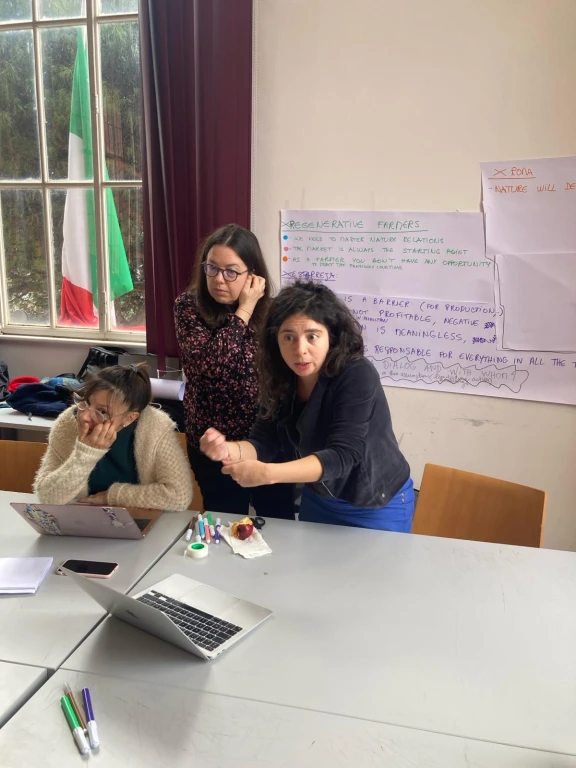
1. Collaborative unlearning dialogue in action at the Consortium Meeting #3, in Rome. Italy, 1 March 2024. Caption: Participants engage in a collaborative "unlearning dialogue" during a TRANS-lighthouses workshop, where researchers and practitioners work together to question assumptions and co-create new knowledge. Credits: Photo by Nathalie Nunes. Source: TRANS-lighthouses project.
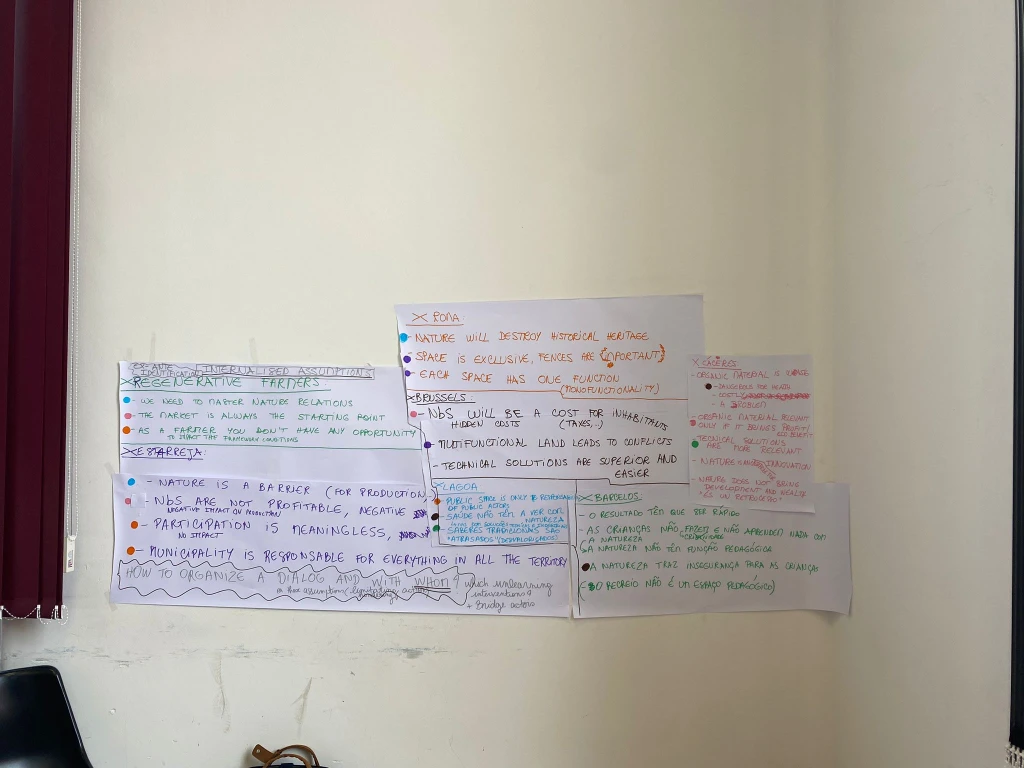
2. Identifying assumptions to unlearn, at the Consortium Meeting #3, in Rome. Italy, 1 March 2024. Caption: A flipchart from a TRANS-Lighthouses workshop documents the process of questioning established beliefs about nature, heritage, and public space. Credits: Photo by Andreia Lemaître. Source: TRANS-lighthouses project.
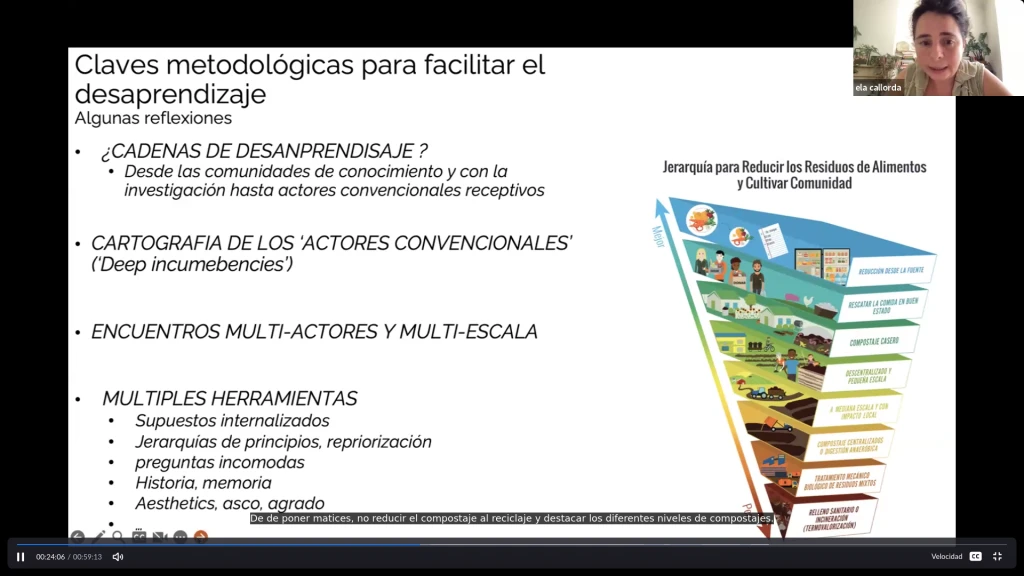
3. Methodological pathways for unlearning in participatory composting. Caption: Slide presented during a statewide Composting Conference in Cáceres (Spain), illustrating methodological approaches to facilitate unlearning processes in the context of decentralised composting. The framework highlights multi-actor and multi-scale engagement, the identification of deep-rooted assumptions, and the use of diverse tools to question established practices. The presentation draws on experiences relevant to Nature-Based Solutions developed within Living Knowledge Labs. Credits: Presentation by Ela Callorda Fossati (Catholic University of Louvain - UCLouvain), as part of the joint participation of UCLouvain, University of Extremadura (UEX) and Economías BioRegionales (EBR) in the TRANS-lighthouses project. Source: Statewide Composting Conference, Cáceres (Spain), organised by Economías Bioregionales as part of the closing of the Mater Compost MITECO peer project.
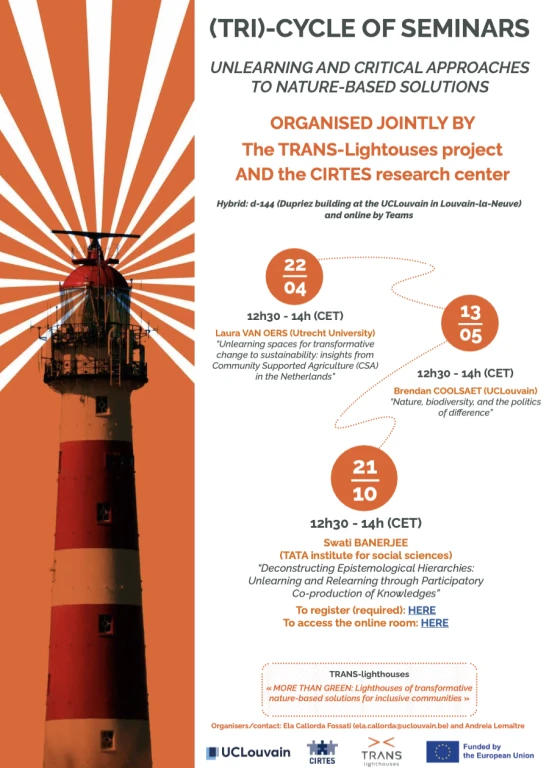
4. (Tri)-Cycle of seminars on unlearning and NbS, 24 April - 13 May - 21 Oct. 2024. Caption: Community-led clean-up of the “Janela do Inferno” trail in Lagoa (Azores), reflecting lived human-nature relations and collective environmental responsibility embedded in the TRANS-lighthouses pilot. Credits: Production by Astrid Baudine (UCLouvain) / TRANS-lighthouses Project / CIRTES / UCLouvain. Source: TRANS-lighthouses project.
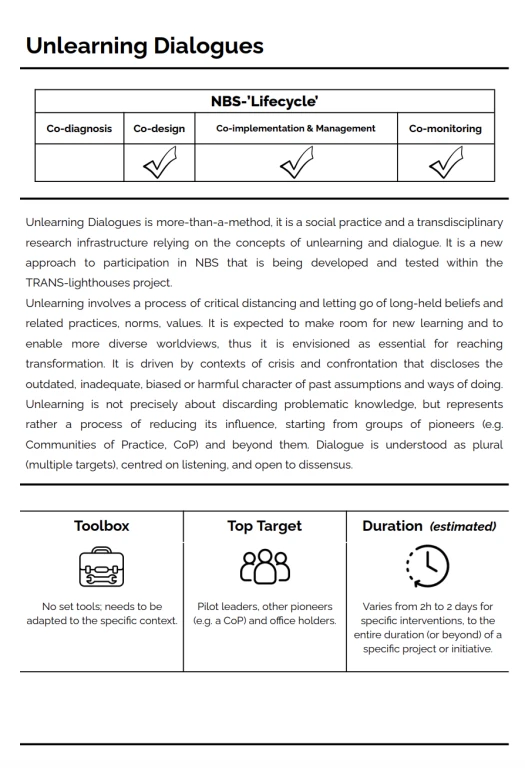
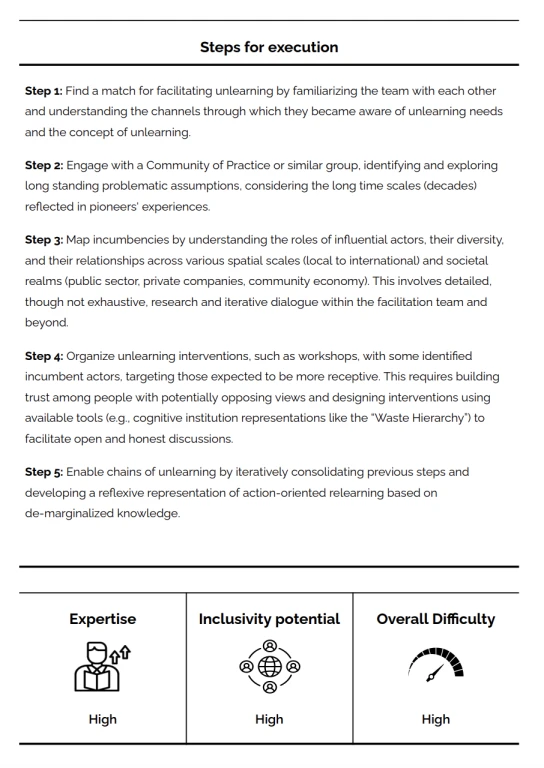
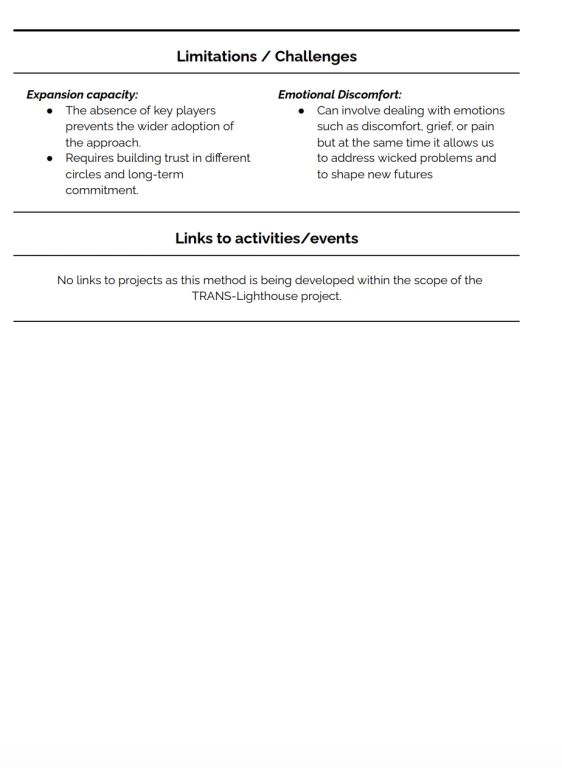
5. Unlearning dialogues - Participatory method. Caption: Visual overview of the Unlearning Dialogues methodological approach developed within the TRANS-lighthouses project to support critical reflection, dialogue and collective learning in Nature-Based Solutions initiatives. The method forms part of a methodological catalogue currently being developed and tested across project pilots. Credits: Ela Callorda Fossati & Andreia Lemaître - UCLouvain. Source: TRANS-lighthouses Project – Deliverable D6.8 (WP6). Methodological catalogue under development. A more advanced version of the catalogue will be released in a future public deliverable.
Learning and unlearning are not side effects of nature-based solutions; they are central to how transformation happens. Across TRANS-lighthouses, Living Knowledge Labs are spaces where communities, practitioners and researchers question assumptions, revisit habits and learn together. From everyday practices and our relation to nature to governance models, nature-based solutions become opportunities not only to build new knowledge, but also to unlearn approaches that do not fit ways of organising collective life and engaging with people and nature. They help initiate and sustain real and deep social and ecological transformation. This blogpost explores why learning and unlearning matter, and how they are taking shape across the project.
A reference framework for learning to unlearn
How do we create conditions not only to learn, but to unlearn?
One of the key scientific contributions emerging from TRANS-lighthouses is a reference framework for learning to unlearn in transdisciplinary Nature-Based Solutions (NbS) settings. Developed through conceptual reflection drawing on different strands of scientific literature on social and ecological transformation, empirical pilots and iterative dialogue across Living Knowledge Labs, the framework addresses a central challenge: transformation requires more than introducing new practices, it requires questioning the assumptions that silently shape them.
Crucially, the project moves beyond a simple substitution logic. Replacing techno-solutionism with “nature-based” interventions does not automatically transform underlying ways of thinking. If dominant ideas about efficiency, scale, governance or expertise remain unchanged, the solution may shift in form but not in logic. Learning and unlearning are therefore framed as processes that accompany NbS as they unfold, not as outcomes measured at the end.
Unlearning as a process of transformation
Learning is widely acknowledged in sustainability processes. Unlearning, however, is rarely addressed, especially in structured, collaborative NbS environments. The framework conceptualises unlearning as a multi-phase, processual dynamic. It unfolds through reflexivity, experimentation and critical dialogue, enabling actors to step back from entrenched routines, institutional logics and hierarchies of knowledge that may limit transformative potential. In this sense, unlearning is not replacement, it is an enabling condition for change.
Importantly, this reflection does not target communities alone. It also challenges researchers, planners and policymakers. In transdisciplinary NbS settings, knowledge is not merely applied, it is negotiated. Learning to unlearn becomes a shared endeavour, reshaping how problems are framed, how evidence is valued, and how responsibilities are distributed across actors, through plural dialogues centred on listening and open to dissent.
From framework to practice: the Cáceres experience
The decentralised composting pilot in Cáceres, Spain, offers a particularly strong empirical grounding for this framework. Often described within the project as a “pilot of pilots” for unlearning, it was designed not only to test decentralised composting initiatives, but to explore their transformative viability. By developing community-based composting systems, local actors directly confronted a dominant governance assumption: that effective waste management must be centralised, industrial and technologically intensive.
As composting initiatives were implemented, monitored and collectively discussed, practical tensions around scale, coordination, regulation and responsibility surfaced. The work was carried out not only with community participants but also with mapped receptive incumbencies. Researchers and community actors jointly identified key power actors in the domain, such as policy-makers, responsible authorities and representatives of large waste management companies, and invited them into the dialogue.
Rather than being treated as obstacles, these tensions became structured moments of reflection within communities of practice and dialogical spaces. Through hands-on experimentation and iterative adjustment, participants began to reconsider what counts as “efficient”, who holds responsibility for waste management, and how value circulates within local ecosystems. Composting thus became not only an environmental intervention, but a living laboratory for questioning institutional logics and rethinking established norms through lived experience.
Reframing Nature-Based Solutions
This interplay between conceptual foundations, living theory and praxis is central to the framework’s contribution. NbS are approached not as fixed technical packages to replicate, but as evolving transdisciplinary processes. Learning expands possibilities, and unlearning creates the conditions for transformation by reshaping how NbS are conceived, implemented and governed.
As TRANS-lighthouses continues, this reference framework is being refined across territories, dialogues and comparative analysis. Its ambition is not only to support better NbS implementation, but to advance how the field understands transformation itself.
Curious to explore how this perspective is unfolding across our pilots and Living Knowledge Labs?
Discover more on our website, explore our resources, and follow the journey across our lighthouses: www.trans-lighthouses.eu
TRANS-lighthouse glossary
Learning & Unlearning
Unlock the language of Nature-Based Solutions: Your essential glossary for the TRANS-lighthouses project!
The featured entry on Learning & Unlearning is part of the TRANS-lighthouses glossary — a living resource continuously enriched throughout the project. Explore other entries such as:
Plurality of Knowledges & Human-Nature Relations
Column images
1. Collaborative unlearning dialogue in action at the Consortium Meeting #3, in Rome. Italy, 1 March 2024. Caption: Participants engage in a collaborative "unlearning dialogue" during a TRANS-lighthouses workshop, where researchers and practitioners work together to question assumptions and co-create new knowledge. Credits: Photo by Nathalie Nunes. Source: TRANS-lighthouses project.
2. Identifying assumptions to unlearn, at the Consortium Meeting #3, in Rome. Italy, 1 March 2024. Caption: A flipchart from a TRANS-Lighthouses workshop documents the process of questioning established beliefs about nature, heritage, and public space. Credits: Photo by Andreia Lemaître. Source: TRANS-lighthouses project.
3. Methodological pathways for unlearning in participatory composting. Caption: Slide presented during a statewide Composting Conference in Cáceres (Spain), illustrating methodological approaches to facilitate unlearning processes in the context of decentralised composting. The framework highlights multi-actor and multi-scale engagement, the identification of deep-rooted assumptions, and the use of diverse tools to question established practices. The presentation draws on experiences relevant to Nature-Based Solutions developed within Living Knowledge Labs. Credits: Presentation by Ela Callorda Fossati (Catholic University of Louvain - UCLouvain), as part of the joint participation of UCLouvain, University of Extremadura (UEX) and Economías BioRegionales (EBR) in the TRANS-lighthouses project. Source: Statewide Composting Conference, Cáceres (Spain), organised by Economías Bioregionales as part of the closing of the Mater Compost MITECO peer project.
4. (Tri)-Cycle of seminars on unlearning and NbS, 24 April - 13 May - 21 Oct. 2024. Caption: Community-led clean-up of the “Janela do Inferno” trail in Lagoa (Azores), reflecting lived human-nature relations and collective environmental responsibility embedded in the TRANS-lighthouses pilot. Credits: Production by Astrid Baudine (UCLouvain) / TRANS-lighthouses Project / CIRTES / UCLouvain. Source: TRANS-lighthouses project.
5. Unlearning dialogues - Participatory method. Caption: Visual overview of the Unlearning Dialogues methodological approach developed within the TRANS-lighthouses project to support critical reflection, dialogue and collective learning in Nature-Based Solutions initiatives. The method forms part of a methodological catalogue currently being developed and tested across project pilots. Credits: Ela Callorda Fossati & Andreia Lemaître - UCLouvain. Source: TRANS-lighthouses Project – Deliverable D6.8 (WP6). Methodological catalogue under development. A more advanced version of the catalogue will be released in a future public deliverable.