Across TRANS-lighthouses, associated partners bring grounded, place-based perspectives that expand how we understand nature-based solutions. In this blogpost, we highlight POLYCOM GIRLS, a women-led organisation in Kenya whose work powerfully connects intergenerational knowledge, human–nature relations, and community-driven learning, reminding us that NbS are also about memory, care, and cultural continuity.
POLYCOM GIRLS: Community knowledge and women-led action
What can nature-based solutions learn from experiences rooted in Kenya? POLYCOM GIRLS offers a compelling answer. As a women-led organisation grounded in long-term community practice, POLYCOM GIRLS brings to TRANS-lighthouses perspectives shaped by intergenerational knowledge, everyday practices of care and close relationships with local ecologies, expanding how transformative NbS can be understood and developed across diverse cultural and territorial contexts.
POLYCOM GIRLS’ journey began through collective self-help initiatives with women and girls in informal settlements in Nairobi. Over time, it evolved into a national organisation working across several counties while remaining deeply anchored in local realities. At the heart of its approach lies the recognition of women and girls as knowledge holders, decision-makers and agents of social and environmental transformation.
Intergenerational knowledge and community-driven NbS
As an Associated Partner of TRANS-lighthouses, POLYCOM GIRLS foregrounds intergenerational learning as a key pathway for community-driven nature-based solutions. Its initiative Nyayo Zetu (“Our Footprints”) focuses on safeguarding and revitalising traditional knowledge related to food and medicinal plants, not as static heritage, but as living knowledge embedded in everyday practices, care relations and territorial belonging. In doing so, it brings into the project perspectives that are often under-represented in mainstream NbS narratives.
A distinctive feature of POLYCOM GIRLS’ work is its capacity to bridge ancestral knowledge and contemporary tools. Through the training of community champions, participatory documentation processes, and the creation of both a community botanical garden and a digital archive, the initiative creates spaces where learning and unlearning unfold together. Younger generations learn from elders while also reinterpreting this knowledge through new media, collective experimentation and community-led communication.
Human–nature relations in practice
This approach reflects a relational understanding of human-nature connections, where plants are not treated merely as resources but as part of cultural identity, health practices and environmental stewardship. In dialogue with TRANS-lighthouses’ emphasis on plural knowledges and reciprocal human-nature relations, POLYCOM GIRLS’ experience illustrates how nature-based solutions can emerge from care, memory and collective responsibility, not only from technical design or infrastructural intervention.
Beyond safeguarding knowledge, POLYCOM GIRLS also demonstrates how community-driven NbS can contribute to social justice and livelihoods. By linking cultural heritage with income-generating activities and collective celebration, the initiative strengthens social ties and reinforces locally grounded futures. From Kenya, POLYCOM GIRLS’ work reminds us that transformative nature-based solutions grow from people, place and shared histories.
Want to know more about POLYCOM?
 |
POLYCOM GIRLS is an associated partner of TRANS-lighthouses based in Kenya, working as a non-governmental organisation with a strong community-driven approach. Its work actively involves local women and girls in the design, implementation and evaluation of projects, recognising them not only as beneficiaries, but as key actors with solutions to the challenges they face in their communities. |
Visit POLYCOM GIRLS’ website: https://polycomgirls.or.ke/
Contact: info@polycomgirls.or.ke
Featured image
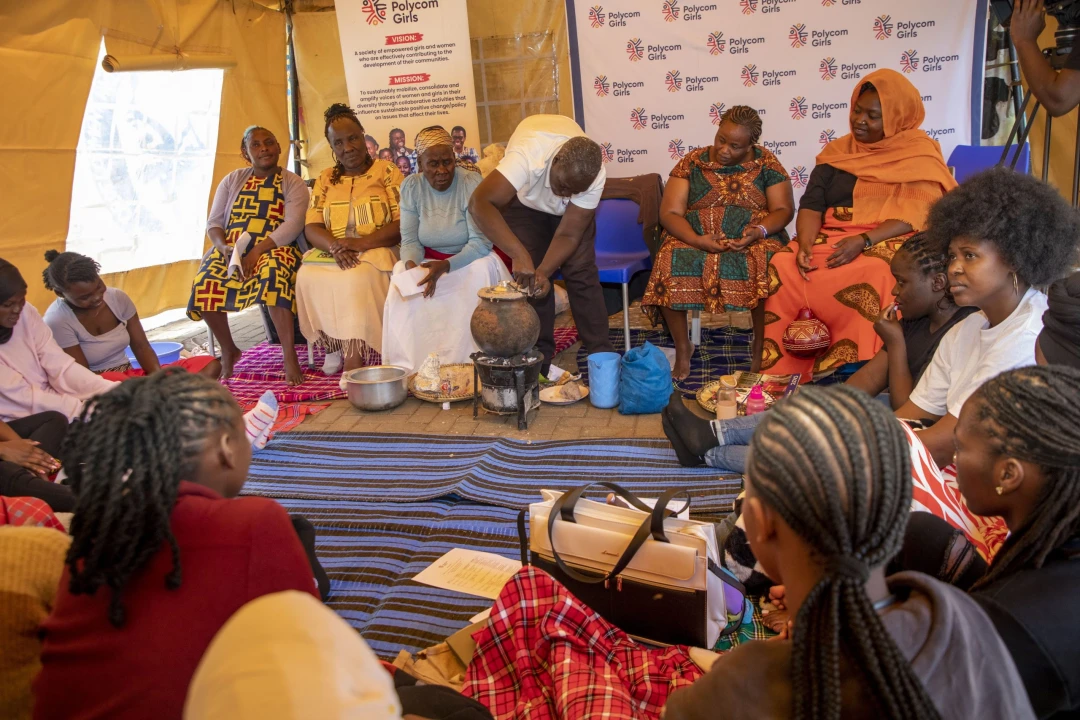
Living knowledge in practice: Learning with plants, across generations. Description: An intergenerational learning circle within the Nyayo Zetu (Our Footprints) project, where women and girls exchange knowledge about food and medicinal plants. The image illustrates how learning, dialogue and care for nature are woven into everyday practices, shaping human–nature relations through collective experience. Credits: POLYCOM GIRLS Development Project. Source: https://polycomgirls.or.ke/2025/11/20/nyayo-zetu-footprints-of-wisdom/
Across TRANS-lighthouses, associated partners bring grounded, place-based perspectives that expand how we understand nature-based solutions. In this blogpost, we highlight POLYCOM GIRLS, a women-led organisation in Kenya whose work powerfully connects intergenerational knowledge, human–nature relations, and community-driven learning, reminding us that NbS are also about memory, care, and cultural continuity.
POLYCOM GIRLS: Community knowledge and women-led action
What can nature-based solutions learn from experiences rooted in Kenya? POLYCOM GIRLS offers a compelling answer. As a women-led organisation grounded in long-term community practice, POLYCOM GIRLS brings to TRANS-lighthouses perspectives shaped by intergenerational knowledge, everyday practices of care and close relationships with local ecologies, expanding how transformative NbS can be understood and developed across diverse cultural and territorial contexts.
POLYCOM GIRLS’ journey began through collective self-help initiatives with women and girls in informal settlements in Nairobi. Over time, it evolved into a national organisation working across several counties while remaining deeply anchored in local realities. At the heart of its approach lies the recognition of women and girls as knowledge holders, decision-makers and agents of social and environmental transformation.
Intergenerational knowledge and community-driven NbS
As an Associated Partner of TRANS-lighthouses, POLYCOM GIRLS foregrounds intergenerational learning as a key pathway for community-driven nature-based solutions. Its initiative Nyayo Zetu (“Our Footprints”) focuses on safeguarding and revitalising traditional knowledge related to food and medicinal plants, not as static heritage, but as living knowledge embedded in everyday practices, care relations and territorial belonging. In doing so, it brings into the project perspectives that are often under-represented in mainstream NbS narratives.
A distinctive feature of POLYCOM GIRLS’ work is its capacity to bridge ancestral knowledge and contemporary tools. Through the training of community champions, participatory documentation processes, and the creation of both a community botanical garden and a digital archive, the initiative creates spaces where learning and unlearning unfold together. Younger generations learn from elders while also reinterpreting this knowledge through new media, collective experimentation and community-led communication.
Human–nature relations in practice
This approach reflects a relational understanding of human-nature connections, where plants are not treated merely as resources but as part of cultural identity, health practices and environmental stewardship. In dialogue with TRANS-lighthouses’ emphasis on plural knowledges and reciprocal human-nature relations, POLYCOM GIRLS’ experience illustrates how nature-based solutions can emerge from care, memory and collective responsibility, not only from technical design or infrastructural intervention.
Beyond safeguarding knowledge, POLYCOM GIRLS also demonstrates how community-driven NbS can contribute to social justice and livelihoods. By linking cultural heritage with income-generating activities and collective celebration, the initiative strengthens social ties and reinforces locally grounded futures. From Kenya, POLYCOM GIRLS’ work reminds us that transformative nature-based solutions grow from people, place and shared histories.
Want to know more about POLYCOM?
|
POLYCOM GIRLS is an associated partner of TRANS-lighthouses based in Kenya, working as a non-governmental organisation with a strong community-driven approach. Its work actively involves local women and girls in the design, implementation and evaluation of projects, recognising them not only as beneficiaries, but as key actors with solutions to the challenges they face in their communities. |
Visit POLYCOM GIRLS’ website: https://polycomgirls.or.ke/
Contact: info@polycomgirls.or.ke
Featured image
Living knowledge in practice: Learning with plants, across generations. Description: An intergenerational learning circle within the Nyayo Zetu (Our Footprints) project, where women and girls exchange knowledge about food and medicinal plants. The image illustrates how learning, dialogue and care for nature are woven into everyday practices, shaping human–nature relations through collective experience. Credits: POLYCOM GIRLS Development Project. Source: https://polycomgirls.or.ke/2025/11/20/nyayo-zetu-footprints-of-wisdom/